Article Info
- Category
- Case Study
- Published
- June 16, 2026
- Language
- 中文 · English
Precision Medical Parts
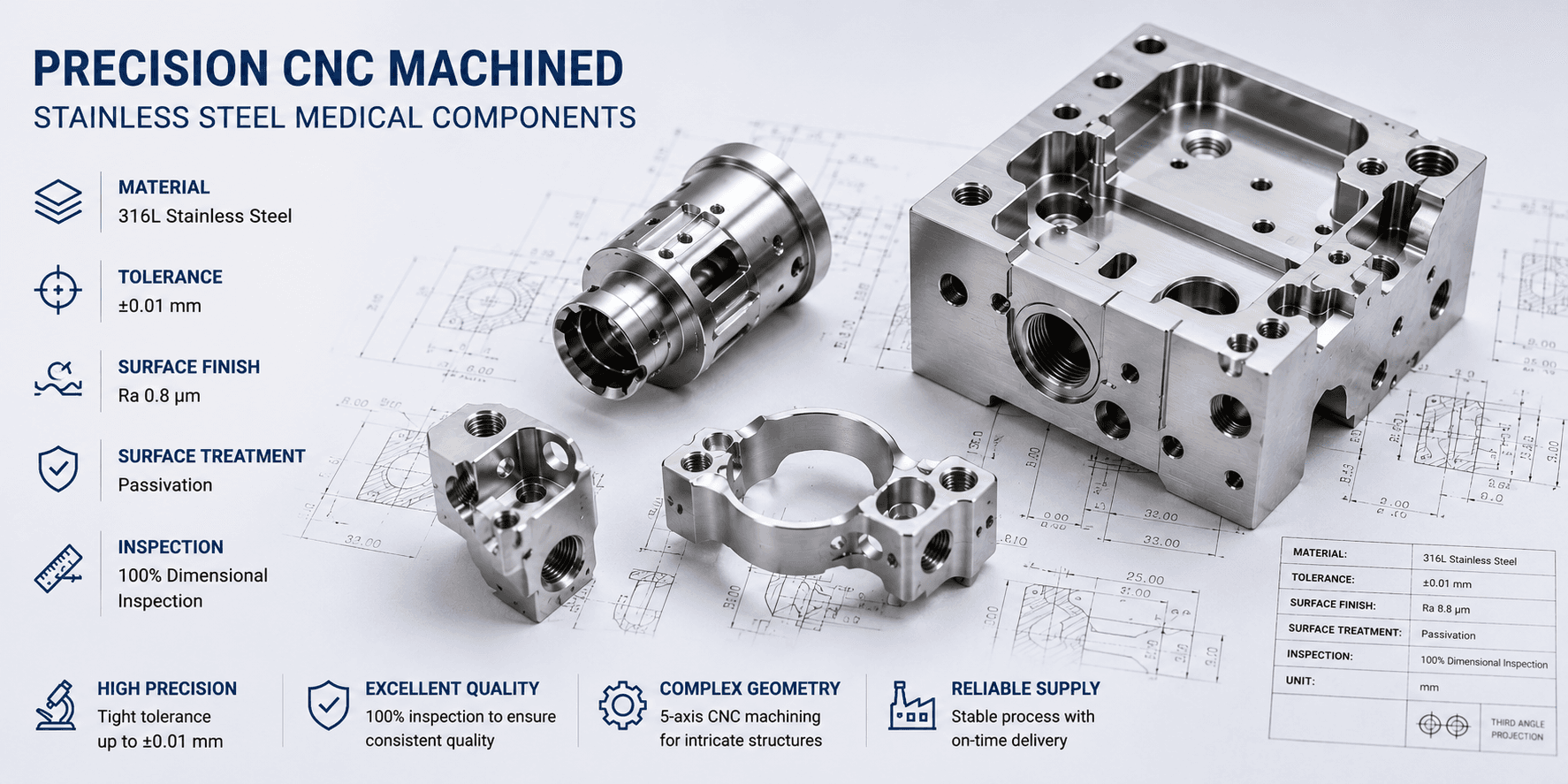
This project involved precision machining of 316L stainless steel medical components using 5-axis CNC milling, precision drilling, and passivation treatment. Critical tolerances were maintained within ±0.01 mm, ensuring excellent dimensional accuracy, surface quality, and stable mass production capability.
Project Background
A medical equipment manufacturer required a series of high-precision stainless steel components for endoscopic auxiliary devices and inspection systems. The parts had to operate in clean environments and demanded excellent corrosion resistance, dimensional accuracy, and superior surface quality. Complex geometries and multiple precision holes also increased manufacturing difficulty.
Material Selection
316L stainless steel was selected for this project because of its excellent corrosion resistance, mechanical strength, and biocompatibility. The material is widely used in medical devices, laboratory equipment, and other high-end industrial applications.
- Material: 316L stainless steel
- Hardness: HB150-190
- Excellent corrosion resistance
- Suitable for clean environments
Machining Process
To meet the complex geometry and tight tolerance requirements, 5-axis CNC machining centers were employed. Multiple manufacturing processes were integrated to improve efficiency and consistency.
- 5-axis CNC milling
- Precision drilling
- Tapping and chamfering
- Deburring process
- Passivation treatment
- Complete dimensional inspection
Special fixtures and optimized tool paths were used to minimize deformation and vibration during machining. Critical dimensions were verified through coordinate measuring machines and in-process inspections to ensure repeatability during mass production.
Tolerance Control
The customer required critical dimensions to be maintained within ±0.01 mm. To achieve this target, high-precision cutting tools, optimized machining parameters, and temperature-controlled inspection environments were implemented.
- Dimensional tolerance: ±0.01 mm
- Hole accuracy: ±0.005 mm
- Surface roughness: Ra0.8
- 100% visual inspection
Surface Treatment
After machining, all components underwent deburring and passivation processes to enhance corrosion resistance and maintain cleanliness. Selected surfaces were additionally polished to satisfy the appearance and functional requirements of medical applications.
Project Results
Following prototype validation and pilot production, the customer highly appreciated the dimensional consistency and surface finish of the components. The project successfully entered long-term mass production with a yield rate exceeding 99%, significantly reducing assembly time and maintenance costs.
With advanced machining capabilities and comprehensive quality control systems, the company provides reliable precision manufacturing solutions for medical devices, automation equipment, and other demanding industrial applications requiring exceptional accuracy and consistency.