Case StudyMay 30, 2026
Article Info
- Category
- Case Study
- Published
- May 30, 2026
- Language
- 中文 · English
CNC Finishing Case for Stainless Steel Welded Frame
This case study presents a stainless steel welded frame project for industrial automation equipment. Through welding deformation control, datum surface machining and CMM inspection, the key mounting surface flatness was controlled within 0.03mm.
【Project Background】
This project involved a customized stainless steel welded frame for an industrial automation equipment customer. The frame was designed to support internal transmission units, guide rail components and inspection modules. In addition to structural strength, the part required stable dimensional accuracy on several mounting datum surfaces to ensure smooth assembly of guide rails, motors, sensors and actuators.
The customer provided complete 3D models and 2D drawings. The part was made from stainless steel profiles and plate components through welding. Because the frame was relatively large and included multiple welded joints, the project focus was not only welding formation, but also controlling post-welding deformation and achieving accurate CNC finishing on key mounting surfaces.
【Machining Challenges】
The main challenge was controlling welding deformation and establishing reliable machining datums after welding. Stainless steel has relatively low thermal conductivity, so local heat input during welding can easily lead to structural distortion. If the welding sequence, positioning method or cooling control is not properly managed, the overall flatness and perpendicularity of the frame may be affected, increasing the difficulty of later CNC machining.
Another challenge was the large frame size and the distribution of several mounting surfaces in different areas. Some machining areas had limited tool access. During machining, the positional relationship between the guide rail mounting surfaces, motor mounting surfaces and inspection module mounting surfaces had to be carefully maintained.
In addition, the customer required the flatness of key mounting surfaces to be within 0.03mm. Several hole positions also needed to remain accurate relative to the main datum, placing high requirements on clamping, alignment, toolpath planning and inspection procedures.
【Process Solution】
Based on the structure of the stainless steel welded frame, Qingdao SCreate Industrial Technology Co., Ltd. developed an integrated process of welding control, stress relief, CNC finishing and CMM inspection. Before welding, the engineering team reviewed the drawings, confirmed the primary locating datums and designed dedicated fixtures to position the profiles and plate parts accurately.
During welding, segmented welding, symmetrical welding and multi-point fixing were used to reduce thermal deformation. For key load-bearing areas, weld strength and structural stability were prioritized. For areas close to machined surfaces, welding heat input was carefully controlled to prevent excessive deformation or insufficient machining allowance.
After welding, the frame underwent stress relief treatment and preliminary dimensional inspection before finishing. During CNC machining, the main datum surface was first aligned and lightly machined to establish a stable machining reference. Then the guide rail mounting surfaces, motor mounting surfaces, locating holes and threaded holes were processed step by step. Multiple in-process measurements and corrections were carried out to ensure stable positional relationships between the mounting surfaces.
【Quality Results】
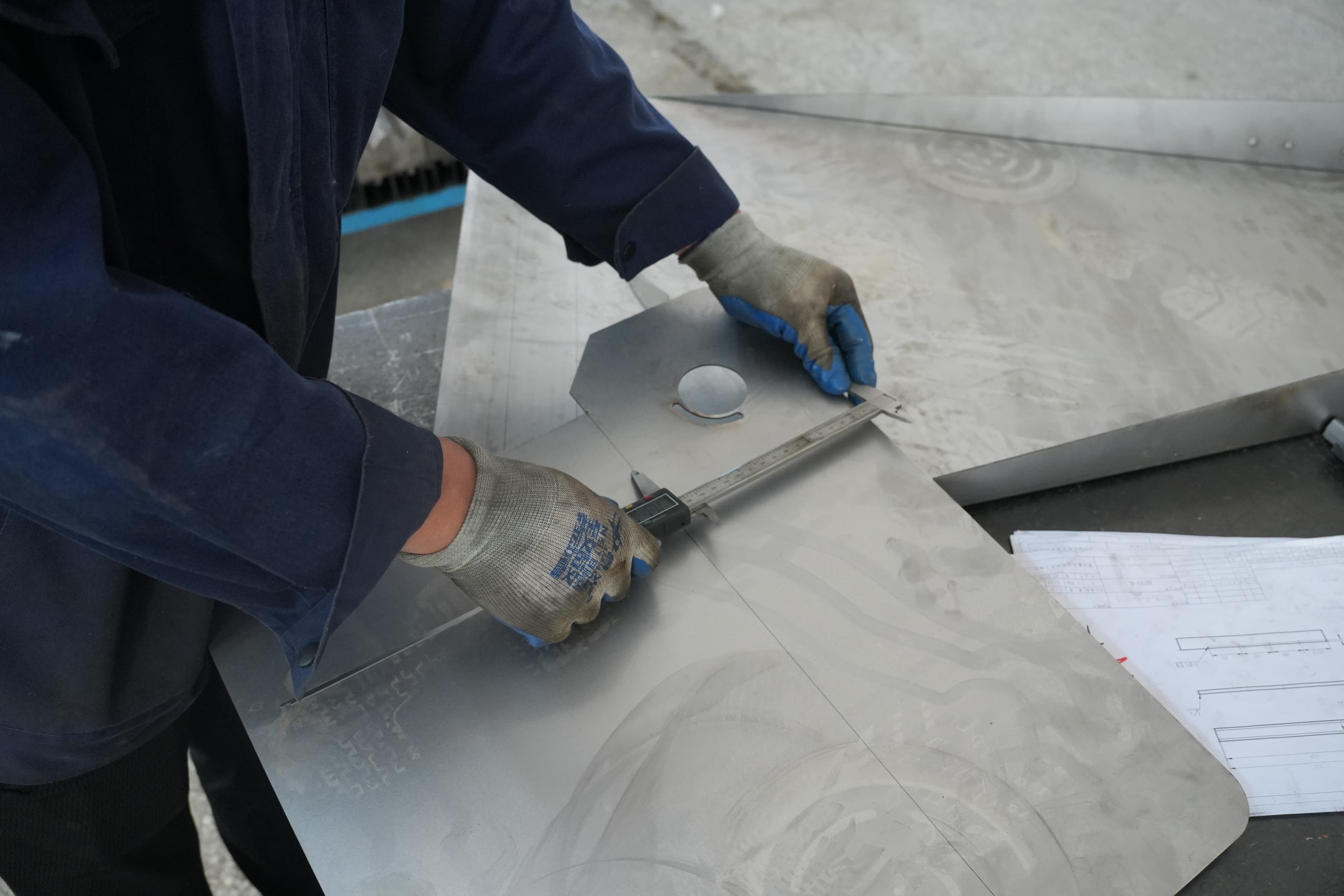
After machining, the quality team inspected the key mounting surfaces, hole dimensions, flatness and perpendicularity using CMM equipment. The inspection results showed that the flatness of key mounting surfaces was controlled within 0.03mm, and the main hole positions and dimensional relationships met the customer’s drawing requirements.
During trial assembly, the customer confirmed that the guide rails, motors and inspection modules could be installed smoothly without secondary rework. The frame structure was stable, the weld appearance was consistent, and the machined surfaces had no obvious vibration marks or burr issues. Through this project, SCreate demonstrated its comprehensive manufacturing capability in stainless steel welded structures, large equipment frames and high-precision mounting datum machining, providing a reliable process foundation for future batch delivery of similar automation equipment frames.